


Tank vs. Tankless Water Heater: What’s the Difference? A Colorado Installation & Replacement Guide

Most water heater decisions get made standing in a puddle. The old tank finally leaks, the house has no hot water, and the replacement becomes whatever can be installed fastest, usually the same type and size as before. That’s understandable, but it’s also why so many homeowners never seriously weigh a tank vs. tankless water heater upgrade. When you plan the replacement before the old unit fails, you get to choose the system that fits your household, your utility bills, and your home’s gas and venting setup, instead of the one that happened to be on the truck.
Here’s an honest comparison of the two, plus the Colorado-specific factors that affect which one makes sense.
Tank vs. Tankless Water Heater: How Each One Works
A tank water heater heats and stores a set volume of water, typically 40 to 80 gallons in residential homes, and keeps it hot around the clock. It’s simple, familiar, and usually less expensive to buy and install. The downside is that it can run out: once the stored hot water is used up, you wait while the tank recovers. It also loses some heat continuously as it keeps that stored water hot.
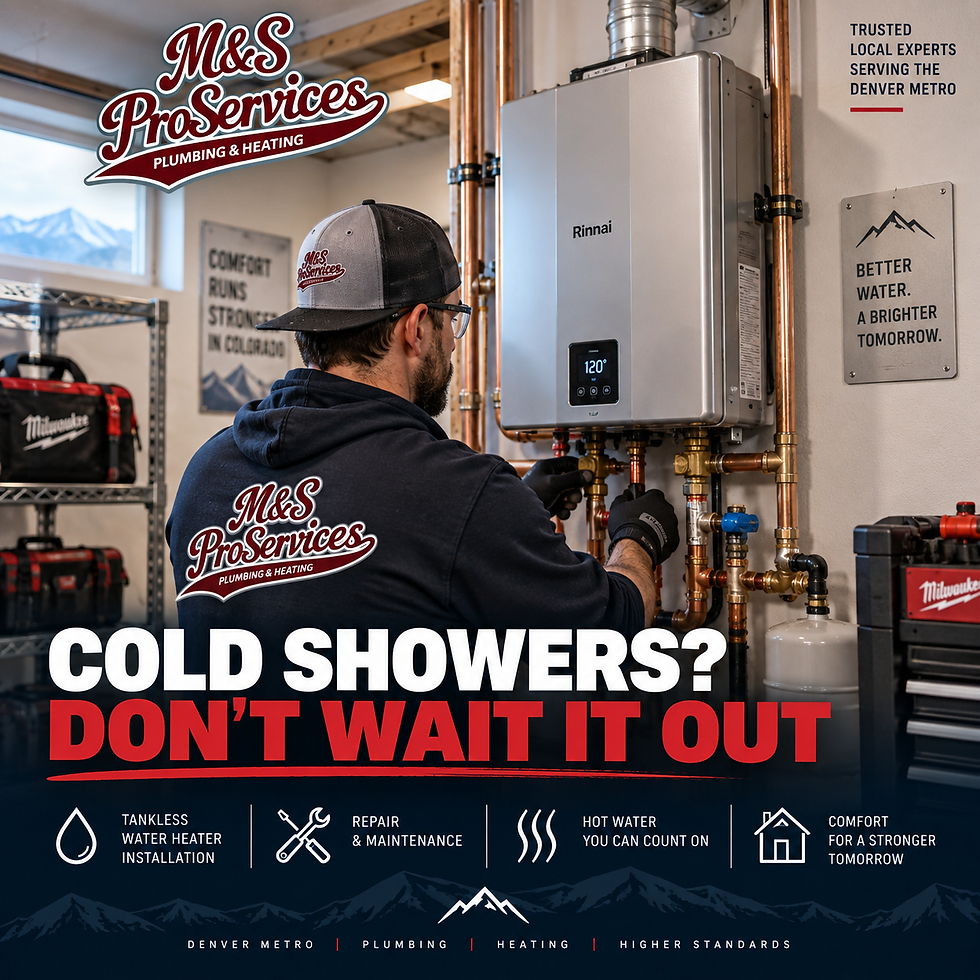
A tankless water heater heats water only when a tap opens, using a high-output gas burner or electric elements as water flows through. It doesn’t run out of hot water as long as demand stays within its capacity, it takes up a fraction of the space, and it avoids the standby losses of a storage tank. In exchange, it costs more upfront, often needs bigger utility connections, and requires regular maintenance to perform well.
Neither is automatically better. The right choice comes down to how your household uses hot water and what your home can support.
Why Colorado Winters Change Tankless Sizing
Here’s a factor that often gets missed in tankless sales pitches. A tankless unit’s real capacity depends on how much it has to raise the water temperature. In winter, the water coming into Front Range homes is much colder than in summer. The colder the incoming water, the harder the unit has to work, and the less hot water it can deliver at once.
A unit sized for summer conditions can fall short in January when two showers and the dishwasher run at the same time. Proper sizing uses your household’s peak demand and cold-season inlet temperatures, not an average.
Altitude matters too. Gas appliances lose some output at elevation, so equipment installed in homes around Boulder or Castle Rock needs to be rated and set up for our altitude. Skipping that step leads to underperformance and service calls later.
The Gas Line Question Nobody Asks Until Install Day
Gas tankless water heaters need a lot of fuel when they fire, far more than a typical tank heater. Many existing gas lines, especially in older homes, weren’t sized for that demand. A tankless unit on an undersized line can starve for gas, cut out during heavy use, or never reach its rated output.
Venting usually changes too. Many tankless units, particularly high-efficiency condensing models, need different venting from the old tank’s flue. Electric tankless models raise a similar question on the electrical side, since they can require major service capacity.
This is where planning pays off. Because we handle gas line installation in-house, we can size the line correctly as part of the job, not discover the problem halfway through an install. That’s one reason a tankless conversion should always start with an in-home evaluation, not a phone quote.
Hard Water and Maintenance: The Long-Term Difference
Water hardness varies by utility along the Front Range, but many Colorado homes deal with mineral scale. In a tank heater, sediment settles at the bottom, reduces efficiency, and can cause rumbling or popping sounds. Flushing the tank periodically and checking the anode rod helps it last longer.
Tankless units are more sensitive to scale because water passes through narrow heat-exchanger passages. In hard-water homes, regular descaling is essential, and many homeowners pair a tankless system with water treatment to protect it. Our plumbing services include water filtration systems that can extend the life and efficiency of any water heater.
Cost Over Time: Upfront Price vs. Operating Cost
Tank water heaters win on upfront cost and installation simplicity, particularly when replacing like-for-like. Tankless systems cost more to buy and install, especially when the gas line or venting needs upgrades, but they typically use less energy and last longer with proper maintenance.
Whether the tankless premium pays off depends on how much hot water your household uses, your energy rates, how long you plan to stay in the home, and how much the installation work costs at your particular house. Larger households with heavy demand usually see the strongest return. A one- or two-person household with modest use may be perfectly well served by a quality tank.
Repair, Replace, or Upgrade?
Not every water heater problem means replacement. Issues like a failed thermocouple, a heating element, a pressure-relief valve, or a worn anode rod can often be fixed. Replacement makes more sense when the tank itself leaks (that can’t be repaired), when the unit is near the end of its expected life, or when repairs keep adding up.
The best time to consider tank vs. tankless water heater options is while your current unit still works. That gives you time to evaluate gas lines, venting, and sizing without the pressure of a cold shower. Homes with a boiler or in-floor radiant heat may also have integrated options worth discussing, which our heating work covers.
Which One Fits Your Home?
Choose a tank if you want lower upfront cost, simple installation, and predictable performance for moderate household demand. Choose tankless if you want continuous hot water, lower operating costs over time, and more space, and if your home’s gas supply and venting can be set up to support it properly. To see how these installations look in real Colorado homes, browse our recent projects.
Whether you’re in Thornton, Boulder, Castle Rock, or anywhere across our service area, contact M&S Pro Services to schedule an in-home water heater consultation and plan your replacement before your old unit makes the decision for you.

Comments