


Water Heater Replacement: Tank vs. Tankless and How to Know When It's Time
A water heater rarely fails without warning — it fails after weeks of showers that run lukewarm a little sooner than they used to, or a faint rumbling sound during heating cycles that gets written off as normal appliance noise. By the time it actually stops producing hot water entirely, most homeowners have been living with the early signs of water heater replacement being necessary for longer than they realized.
Why Water Heaters Give Warning Signs Most People Miss
Sediment buildup inside a tank water heater is one of the most common — and most overlooked — precursors to failure. As mineral deposits accumulate at the bottom of the tank, especially in a Colorado market known for mineral-heavy water, the heating element has to work harder to reach the same temperature, which shows up as longer wait times for hot water, a rumbling or popping sound during heating cycles, and gradually declining capacity even though the tank size hasn't changed. None of these symptoms mean immediate failure, but together they're a reliable signal that a water heater installation conversation is coming sooner rather than later.
Tank vs. Tankless: The Decision That Actually Matters
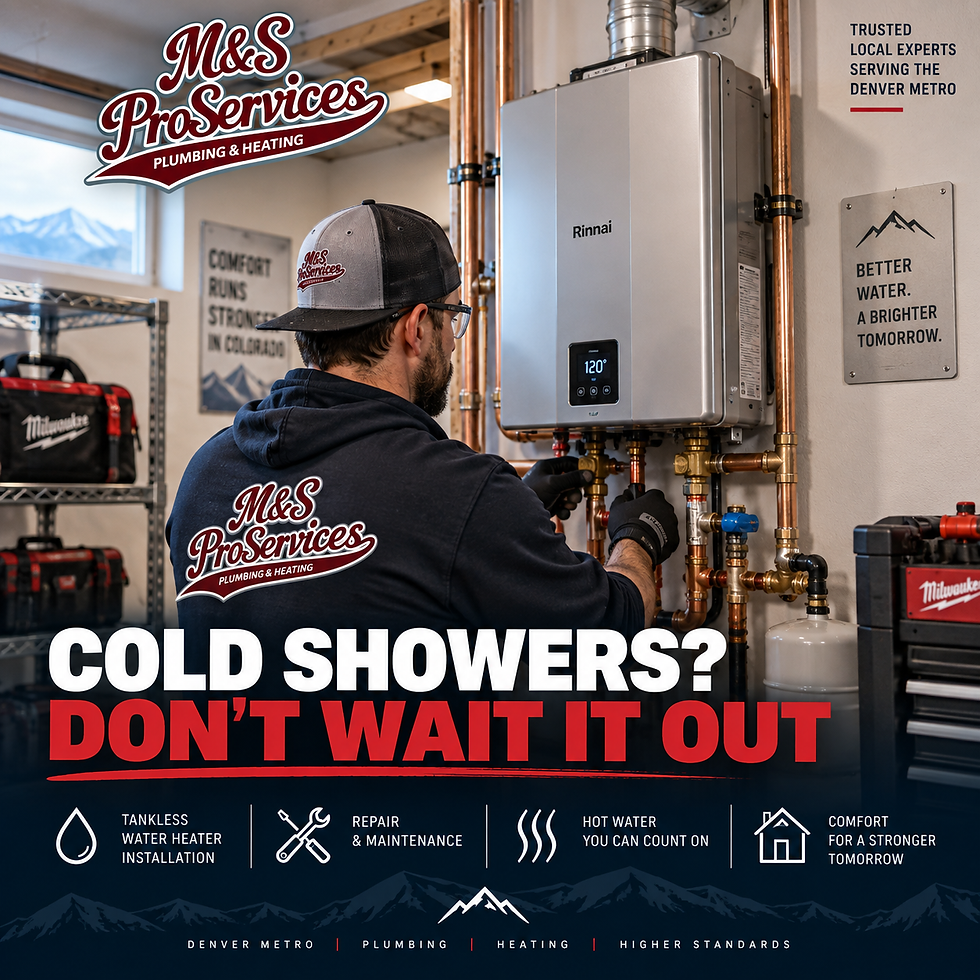
The biggest decision in any water heater replacement isn't which brand or which gallon capacity — it's whether to stay with a traditional tank system or switch to tankless. A traditional tank system heats and stores a set volume of water continuously, which means reliable performance but a finite hot water supply during high-demand periods like back-to-back showers. A tankless system heats water on demand, providing continuous hot water without storage limitations, but requires adequate gas line capacity and, in some cases, upgraded venting — considerations that affect installation cost and complexity beyond just the unit price itself. Neither option is universally better; the right choice depends on household hot water demand, existing infrastructure, and long-term energy efficiency goals.
The Hidden Bottleneck: Colorado's Water Quality Changes the Math
Homeowners comparing water heater replacement options often treat the tank-versus-tankless decision as if it plays out the same everywhere, but Colorado's mineral-heavy water changes the calculation in a way that's easy to overlook. Hard water accelerates sediment buildup in tank systems, shortening their effective lifespan compared to the same unit operating on softer water elsewhere in the country. Tankless systems are also affected by hard water, but differently — scale buildup on the heat exchanger can reduce efficiency and require more frequent flushing maintenance than a tankless system would need in a lower-mineral-content region. A water filtration system installed alongside either type of water heater can meaningfully extend its service life, which is worth factoring into the total cost comparison rather than evaluating the water heater in isolation.
Installation vs. Repair: Why This Isn't Always a Replacement Decision
Not every water heater problem calls for full replacement, and it's worth being direct about that before assuming this is a bigger project than it needs to be. A failed heating element or thermostat on an otherwise sound tank, especially one under eight years old, is often a straightforward repair rather than a full replacement. The math shifts once a unit is beyond its typical 10–12 year expected lifespan, has visible tank corrosion or leaking, or has multiple components failing in succession — at that point, continuing to repair an aging unit usually costs more over time than moving to replacement, particularly when factoring in the risk of a tank failure that causes water damage.
Sizing a Replacement Correctly for Basement and Remodel Projects
Water heater replacement decisions often surface during broader projects — a basement finishing project that needs to account for water heater placement and capacity for added bathroom fixtures, or a bathroom remodel that increases overall household hot water demand. Sizing a replacement unit based only on current household needs, without accounting for planned additions like a finished basement bathroom, is a common oversight that leads to inadequate hot water capacity almost immediately after a renovation is complete.
Why Planned Replacement Beats Emergency Replacement
A water heater that's approaching the end of its expected lifespan is a much easier and more cost-effective replacement to plan than one that fails completely and floods a utility closet or basement. Homeowners across Thornton, Denver, and Erie who replace proactively — based on age and warning signs rather than waiting for total failure — avoid the water damage risk and the premium that comes with an emergency same-day replacement versus a scheduled installation.
If your water heater is showing signs of age — slower recovery time, unusual noise, or inconsistent temperature — schedule a water heater assessment with M&S Pro Services to find out whether repair or replacement makes more sense for your home.


Comments